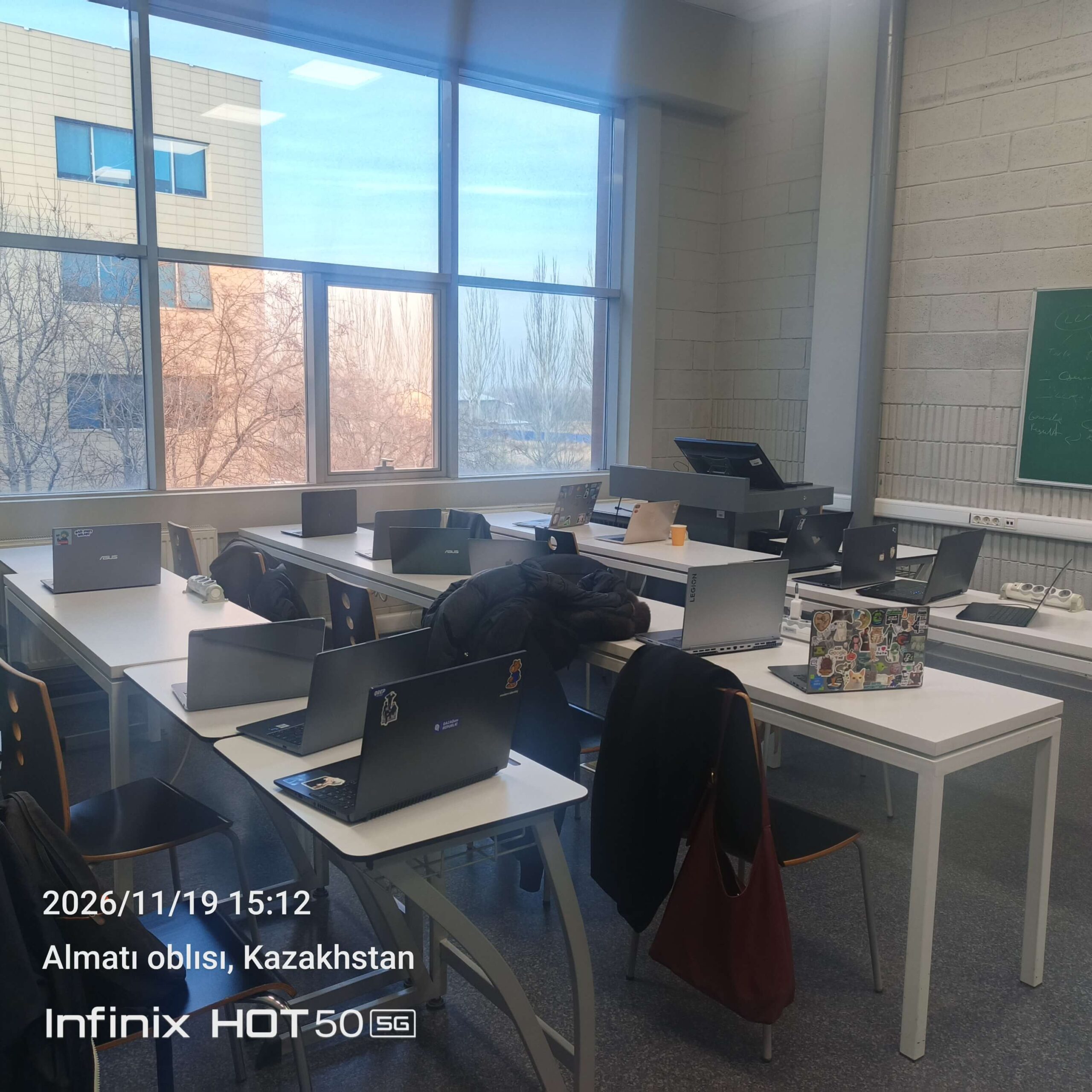
I have been teaching in Kazakhstan for some time now — started in 2019, and minus the pandemic (when I continued teaching online), there has not been a break from the classroom. During this period, I have had the opportunity to teach across different universities, as well as at different levels, both Master’s and Bachelor’s.
Of course, teaching comes with its own set of diverse scenarios, and no two classrooms or students are alike. That said, across universities and departments, and across classrooms and courses, there is one aspect that I have noticed which seems to remain a rigid constant in Kazakhstan — flagship technical hardware or, more specifically, laptops.
And to be even more precise, almost every student that I come across carries at least a MacBook or a Lenovo Legion (or something similar, high-spec). For quite a while, this has sparked my curiosity.
Student Laptops – High Tier Everywhere?
Back in my college days, it was normal for students like me to show up for class with a beat-up ThinkPad or a slightly worn-out phone. From what I have seen, even today, older hardware carries zero friction in classrooms and campuses in many places.
However, in Kazakhstan, visible consumer tech carries immense signalling power — this is my first observation. Carrying a flagship device such as a MacBook commands ambition, modernity, and normalcy — “if you are studying to be an IT guru, your hardware should match”. As such, modest mid-range devices are an anomaly in most university lecture halls.
But the interesting aspect? Kazakhstan’s national median monthly wage sits around 317,500–331,500 KZT, while the nominal average hovers near 461,500–486,400 KZT. [1] In cities such as Almaty and Astana, average salaries reach roughly 520,000–560,000 KZT, give or take. [2]
By this maths, paying upfront for a high-tier device can easily consume several months’ gross income.
This is where certain structural nuances come into play.
The Psychology of 0-0-12 and 0-0-24
In Kazakhstan, ‘Buy Now, Pay Later’ rails are paramount, especially visible in promotions such as Kaspi Juma and various other competing bank promotions, wherein consumers can finance goods with zero down payment and 0% nominal interest over 12 or 24 months. [3]
Naturally, this makes it comfortable for buyers to think in terms of monthly cash flow, as they can split a 750,000 KZT laptop into easier monthly instalments of, say, 31,250 KZT — this is a number that is trivial as compared to rent or groceries and thereby reduces the psychological barrier.
On the flip side, Kaspi (and other such providers) charges merchants a decent commission to offset the 0% interest. [4] As a side effect, it is not uncommon for laptop retailers in Kazakhstan to bake such financing costs directly into the sticker prices. A laptop that may otherwise be 500,000 KZT elsewhere can easily balloon to 750,000+ KZT in Kazakhstan.
Such inflated prices further encourage instalment buying, as paying cash upfront feels like losing money to inflation. Among other things, parallel imports and unofficial retail channels, too, may have a role to play in this, as inflated pricing almost always leads to outlets where the same device can be had for a mild to modest discount.
This is a strong reason why most buyers, especially students, tend to opt for higher-end devices — the inflated pricing simply makes mid-tier or lower-spec gadgets not worth the money.
“Store of Value” and Resale Loops
Central Asian economies are not immune to periodic currency fluctuations. Any high-end, recognizable tech purchase, such as an Apple MacBook or a comparable gaming laptop, is often viewed as a liquid asset.
Most budget laptops, especially ones under 250,000 KZT, lose most of their resale value within the first year or so. On the other hand, an M-series MacBook or a Legion can easily retain nearly 70% of its resale value, making it sellable on OLX within days, not weeks.
Such a ‘store of value’ mechanism fosters two things — an incentive to invest in high-spec gadgets that can be exchanged or sold later on with relative ease, and a habit of incremental updates, such that buying a higher-spec gadget today leads to buying a yet better one tomorrow.
Gadgets as Social Currency
At the outset, I assumed my observation was skewed. After all, a classroom in Astana or Almaty — like the ones I tend to teach — is not a statistical cross-section of the country at large. In Kazakhstan, regional income gaps can be stark, with wages in major cities being almost double those in smaller regions such as Turkistan. [5] That said, even in universities in smaller regions, tech signals are very real, and the laptops or other gadgets are not weaker by any means.
This is where social currency and social signalling come in.
In most Kazakh families, higher education is viewed as a collective milestone. Owning a quality device that will last the four years of the Bachelor’s degree is a prerequisite, not an afterthought. Quite a decent number of students skip Master’s degrees and go straight into industry after finishing their undergrad. This is why having a flagship device is viewed as more of a preparatory step towards a career boost, and rarely as flamboyance.
Beyond that, another plausible factor is that I teach mostly ICT and related disciplines, such as Parallel Computing, and that’s the exact student segment I generally observe. Amid Kazakhstan’s rapid digital transformation and booming fintech sector, a career in IT is seen as the surest path to upward mobility — any money that goes towards a laptop for coding is money well spent, even if that laptop is overkill for coding.
Conclusion
As I walk through the lecture halls at the university, the hardware on the desks is nothing short of what you would find in a co-working hub somewhere in Silicon Valley. But one look at the broader macroeconomic data reveals that a very different economic engine is powering it.
Naturally, the intricate financial and social ecosystem in Kazakhstan has adapted itself well to stretch time and liquefy aspiration. After all, I can see how well my own students have transformed depreciating electronics into a portable, inflation-hedged store of value; an asset class that also happens to compile code and edit video.
Ultimately, the high-end laptops resting on a university desk in Kazakhstan are wonderful artefacts of adaptation, underwritten by globalized consumer desire, accessible financing, and the considerable importance families attach to higher education. Few places have turned consumer credit and resale liquidity into an informal educational infrastructure quite like Kazakhstan. Having a flagship laptop on almost every lecture-hall desk is both distinctly Kazakh and undeniably impressive.
References (Last Accessed 19 November, 2026 / 16.28 Almaty Time)
- Bureau of National Statistics of the Agency for Strategic Planning and Reforms of the Republic of Kazakhstan (BNS ASPR RK). Wages and Working Conditions (Q1 & Q2 2026); and Differentiation of Wages of Workers in the Republic of Kazakhstan (2025).
- Bureau of National Statistics of the Agency for Strategic Planning and Reforms of the Republic of Kazakhstan (BNS ASPR RK). Wages and Working Conditions Hub.
- Kaspi Guide. Official Kaspi Juma 0-0-24 Client Conditions.
- Kaspi Partner Guide. Promotional 0-0-12 & 0-0-24 Merchant Commissions.
- Bureau of National Statistics of the Agency for Strategic Planning and Reforms of the Republic of Kazakhstan (BNS ASPR RK). BNS Report: Number and Wages of Employees in Q1 & Q2 2026.
Featured Image: Clicked in SDU classroom; dated 19th Nov 2026; laptops belong to students – 16 devices (of which 7 MacBooks, 5 gaming rigs).

Leave a Reply